

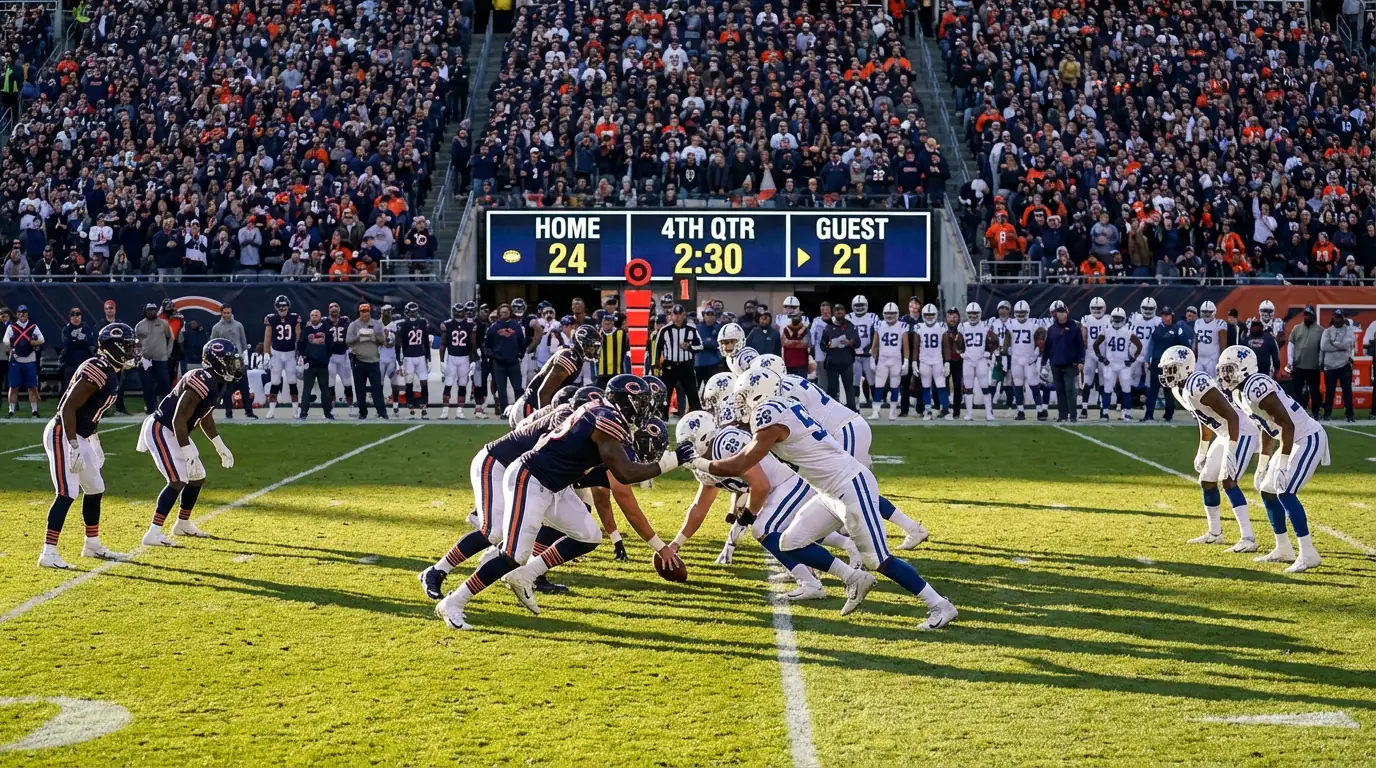
There is a certain freedom in not caring who wins. Totals betting — also called over/under betting — removes the question of which team is better and replaces it with a different one: how many combined points will both teams score? The sportsbook sets a number, and you decide whether the actual combined score will finish over or under that line.
For a lot of football bettors, totals are an afterthought. They check the spread, maybe glance at the moneyline, and ignore the total entirely. That is a mistake. The totals market is where some of the most exploitable inefficiencies in football betting live, largely because the factors that drive scoring — weather, pace, defensive matchups, injury reports — require a different analytical toolkit than the one most bettors bring to spread handicapping.
How Over/Under Totals Are Calculated
A totals line represents the sportsbook’s projection for the combined final score of both teams. If the total for a game between the Green Bay Packers and the Chicago Bears is set at 44.5, you can bet the over (expecting 45 or more combined points) or the under (expecting 44 or fewer). Like spreads, both sides are typically priced at -110, and the half-point eliminates the possibility of a push.
The number itself is derived from a blend of offensive and defensive efficiency metrics, historical scoring trends between the two teams, venue-specific data, and anticipated game flow. Oddsmakers do not simply average each team’s season scoring totals and add them together — though that is a reasonable first approximation for casual analysis. They also account for pace of play, which measures how quickly each team runs its offense. A game between two up-tempo teams that run 70 plays per game will have a higher total than a game between two grind-it-out teams that control the clock, even if their per-play scoring efficiency is similar.
When the total is set at a round number like 44 or 47, pushes become possible, and the sportsbook is essentially acknowledging a precise midpoint in its model. Some bettors prefer round-number totals because pushes protect the bankroll; others find them frustrating because a pushed bet ties up capital without producing a return. Half-point totals like 44.5 force a clean outcome every time, which is why they dominate the market.
Factors That Move Totals
Weather is the single most impactful external factor on totals, and it is consistently underweighted by recreational bettors. Wind above 15 mph measurably suppresses passing efficiency, which in turn reduces scoring. Rain and snow compound the effect by increasing fumble rates and making downfield throws more difficult. Games played outdoors in December and January — particularly in stadiums like Lambeau Field, Soldier Field, or Highmark Stadium — tend to land under more often than the market expects, especially when wind chill enters the picture.
Temperature itself tells only part of the story. A 25-degree day with no wind in a dome-adjacent market is very different from a 25-degree day with 20 mph gusts off Lake Erie. The relevant metric is sustained wind speed, not temperature, and the bettors who track hourly forecasts rather than relying on generic “cold weather” narratives have a real edge. Several publicly available weather APIs provide stadium-level wind data in the hours before kickoff, and the information is free.
Pace and game script are the internal factors that matter most. A game between two pass-heavy offenses that average 32 points per game each looks like an obvious over candidate. But if one of those teams also plays elite red-zone defense — allowing drives but limiting touchdowns — the game might produce a lot of field goals and fewer total points than the raw averages suggest. Conversely, two mediocre offenses facing two weak defenses can produce a surprisingly high-scoring game because defensive stops are rare and possessions are long but productive. The interaction between offensive style and defensive weakness matters more than the headline scoring averages.
Injuries to key players also move totals, though the market is generally efficient at pricing in confirmed absences. Where edges appear is in the gray area of game-time decisions — when a starting quarterback is listed as questionable with a foot injury and the backup is a significant downgrade. If the starter ultimately sits, the total may not have adjusted fully because the market priced in a probability-weighted blend of both scenarios. Bettors who wait for final injury reports and react quickly can sometimes find totals that have not yet caught up to the news.
Strategies for Betting Totals
The most common beginner approach to totals is to look at two high-scoring offenses and slam the over. It works sometimes, but it is not a strategy — it is pattern recognition without depth. Sustainable totals betting requires thinking about the game at a structural level.
Start with defensive matchup analysis rather than offensive output. The over/under is not determined by how good the offenses are in isolation; it is determined by how the offenses perform against the specific defenses they are facing. A team averaging 28 points per game against bottom-tier defenses might manage only 17 against a top-five pass rush. Defensive DVOA, pressure rate, and red-zone defense percentage are better predictors of game totals than raw points scored because they account for the quality of opposition.
Second, pay attention to rest and scheduling. Teams playing on short rest — Thursday night games, for example — historically produce lower-scoring contests. Fatigue affects offensive execution more than defensive effort, at least in the first half, and the result tends to be sloppy play, more punts, and fewer points. The market has started to price this in more efficiently over the years, but Thursday-night unders still carry a slight edge in certain matchup configurations, particularly when both teams are coming off physical Sunday games.
Third, consider the referee crew. This might sound like an oddity, but different officiating crews call penalties at meaningfully different rates. Crews with high penalty flags per game tend to slow down the pace and extend drives through first downs via defensive penalties, creating a complex effect on scoring. Some crews also have higher rates of pass interference calls, which inflate passing yardage and can push games over. Historical crew data is publicly available and takes only a few minutes to incorporate into your analysis.
Alternate Totals and Team Totals
Beyond the standard total, most sportsbooks offer alternate totals — lines set above or below the primary number at adjusted prices. If the standard total is 44.5 at -110 each way, you might find an alternate over at 48.5 for +150 or an alternate under at 40.5 for +140. These markets allow you to express a stronger directional opinion with higher potential payouts or to buy a more comfortable cushion at a steeper price.
Team totals add another dimension. Instead of betting on the combined score, you wager on how many points a single team will score. If the Packers’ team total is set at 24.5, you are betting on whether Green Bay scores 25 or more, independent of what Chicago does. Team totals are useful when you have a strong read on one side of the ball but less conviction about the other. If you believe the Packers’ offense will dominate but have no opinion on the Bears’ scoring, a Packers team total over is a cleaner expression of your thesis than a full-game total, which requires both offenses to cooperate.
Alternate and team totals also serve as building blocks for same-game parlays, where combining a team total with a spread or moneyline can produce correlated legs that amplify each other’s probability. A Packers -7 spread paired with a Packers team total over 24.5 has natural correlation — if Green Bay scores enough to cover a touchdown spread, they have probably cleared 24.5 as well. Sportsbooks adjust SGP pricing to account for this correlation, but the relationship is still worth understanding.
The Ghost Points
There is a phenomenon in football betting that experienced totals bettors know well but rarely hear discussed: the points that almost happened. A dropped pass in the end zone, a field goal that clangs off the upright, a fumble at the two-yard line — these are plays that affect the actual score but not the underlying quality of the drives that produced them. They are ghost points, and they haunt bettors who focus only on the final number.
Every football game contains a shadow score — the total that would have occurred if every drive had resolved according to its expected value rather than its actual outcome. Red-zone efficiency fluctuates wildly from game to game, and it is one of the least stable stats in football. A team that converts 80% of red-zone trips into touchdowns one week might convert only 40% the next, not because they got worse but because a tipped pass and a holding penalty changed two possessions from touchdowns to field goals.
This is why totals bettors who rely on recent box scores are often surprised. A team that scored 10 points last week might have generated 400 yards of offense and simply failed to finish drives. The underlying offensive quality was strong; the scoring was not. Totals bettors who dig into drive data, expected points added, and red-zone opportunity counts develop a more stable picture of what a team’s scoring output should be, rather than what it happened to be on a given Sunday. The ghost points are not on the scoreboard, but they are in the data — and they are often more predictive than the points that actually counted.
