

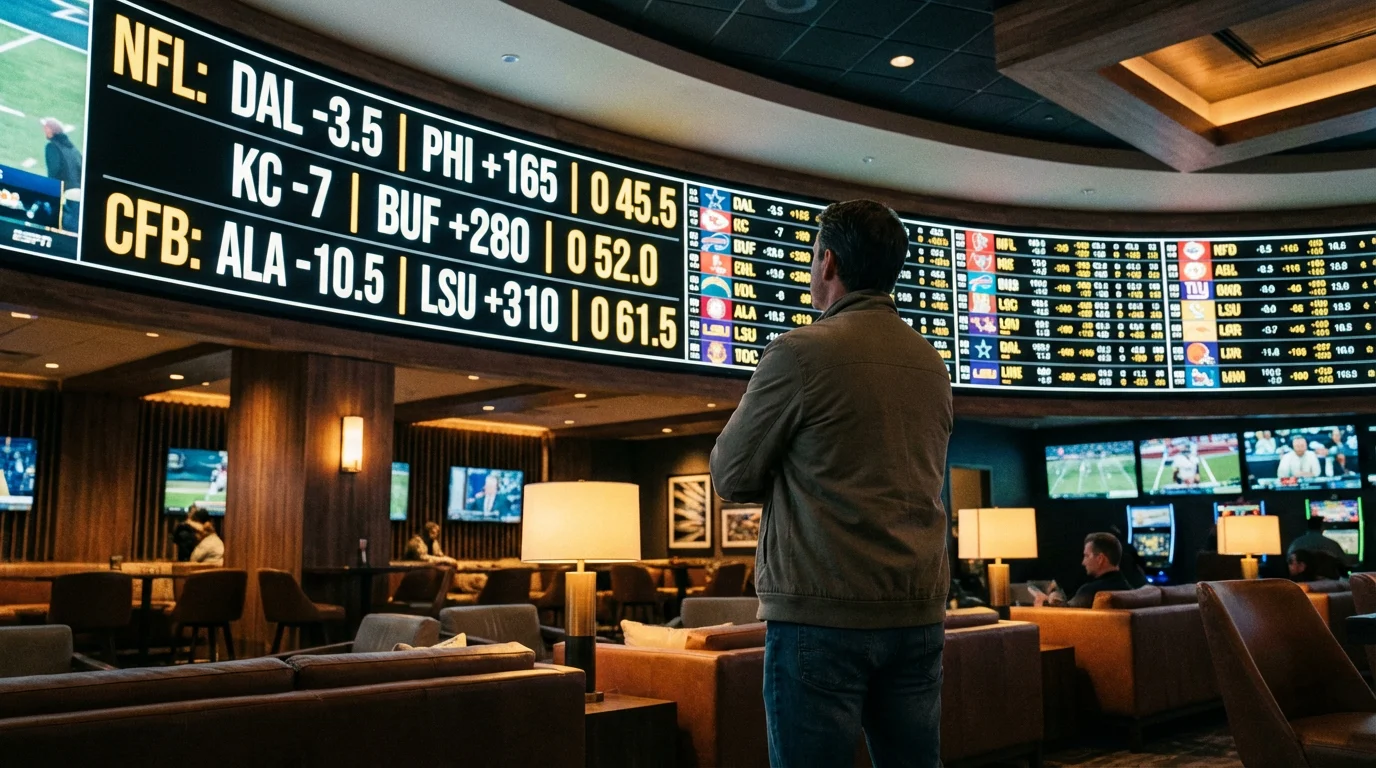
Every sportsbook in the world is a business, and every business needs revenue. In football betting, that revenue comes from the vig — short for vigorish, also called juice, the cut, or simply the margin. It is the built-in commission that ensures the sportsbook profits regardless of which side of a bet wins. If you have ever wondered why both sides of a spread are priced at -110 instead of even money, the vig is the answer.
Most bettors are vaguely aware that the house takes a cut. Fewer understand how large that cut actually is, how it compounds over hundreds of bets, and how shopping for lower vig is one of the simplest ways to improve long-term profitability without improving your handicapping by a single percentage point. The vig is not dramatic. It is not exciting. It is also the single biggest drag on your bankroll, and ignoring it is the quietest way to go broke.
Calculating the Cost of the -110 Line
The most common vig structure in NFL betting is -110 on each side of a point spread or total. That means you risk $110 to win $100. If you bet both sides of the same game — which you would never do intentionally, but the math is illustrative — you would stake $220 total and guarantee a return of $210 (the $110 stake plus $100 profit from the winning side). The missing $10 is the vig. It represents a 4.55% take on each individual bet, or roughly a 4.76% overround when you calculate the combined implied probabilities.
Here is how the implied probability math works. At -110, each side implies a win probability of 52.38% (110 / 210). Add both sides together: 52.38% + 52.38% = 104.76%. In a vig-free world, the two sides would sum to exactly 100%. The excess — 4.76 percentage points — is the sportsbook’s theoretical margin on the market. This means that to merely break even at -110 prices, you need to win 52.38% of your bets, not 50%. That extra 2.38% sounds trivial. It is not.
Over 1,000 bets at $110 per bet, a bettor winning exactly 50% of the time — a perfectly average handicapper — would lose $5,000. That is 1,000 bets times $5 in expected loss per bet (half the time you lose $110 instead of $100, costing you an extra $10 on every other bet). Over a single NFL season of 20 bets per week across 18 weeks, a 50% bettor loses roughly $1,800 in vig alone. The sportsbook does not need you to lose more than you win. It just needs you to not win enough to overcome the margin.
How the Vig Varies Across Markets
Not all markets carry the same vig. The standard -110/-110 structure applies primarily to point spreads and totals — the highest-volume markets where sportsbooks compete most aggressively for action. Other markets are priced less competitively, which means higher vig and a steeper hill to climb.
Moneyline markets on lopsided games tend to carry more vig. A game with a -300 favorite and a +240 underdog has an implied probability sum well above 105%, sometimes reaching 108% or more. The sportsbook is padding both sides because the lower volume on mismatched games does not allow them to balance the book as precisely. If you are betting moneylines on heavy favorites or steep underdogs, you are paying a premium that does not exist in the spread market.
Player props are another high-vig environment. A typical prop might be priced at -115 on each side rather than -110, pushing the overround above 5.5%. Some sportsbooks go further, pricing props at -120/-110 or even -125/-105, creating combined margins of 6-7%. The reason is structural: prop markets are thinner, less liquid, and more vulnerable to sharp action, so the sportsbook compensates by widening the margin. For bettors who specialize in props, this means you need an even larger edge per bet to overcome the built-in cost.
Futures markets carry the highest vig of all. A Super Bowl futures market with 32 teams might have implied probabilities that sum to 130% or more, reflecting a 30-percentage-point margin distributed across dozens of outcomes. Part of this is genuine uncertainty — the further out the event, the harder it is to price — and part of it is the sportsbook’s protection against sharp early movers who spot mispriced teams before the market corrects. Futures can still offer value if you identify a team whose true probability significantly exceeds its implied probability, but you need a larger edge to justify the higher vig.
Parlay pricing introduces yet another layer of vig. When you combine multiple legs into a parlay, the sportsbook compounds the vig from each individual leg. A two-leg parlay at -110 per leg pays roughly +264, but the true odds of hitting two 50-50 propositions are +300 (3-to-1). The difference is the compounded vig, and it grows with each additional leg. By the time you reach a five-leg parlay, the cumulative vig can exceed 30%, which is why parlays are often called the sportsbook’s best friend.
Finding Reduced Vig: Where to Pay Less
The most efficient way to improve your football betting results without improving your handicapping is to pay less vig. It sounds obvious because it is obvious, yet the majority of recreational bettors use a single sportsbook and accept whatever price is posted without comparison.
Reduced-juice sportsbooks exist and they are not difficult to find. Several prominent U.S. operators offer standard lines at -105 instead of -110, either as a permanent feature or as a promotional incentive for high-volume bettors. The difference between -110 and -105 is not trivial. At -105, the breakeven win rate drops from 52.38% to 51.22%. Over 1,000 bets, that 1.16-percentage-point reduction translates into roughly $2,500 in saved vig at $100 per bet. You have not gotten smarter. You have not found better picks. You have simply paid a lower fee to play the same game.
Line shopping across multiple sportsbooks accomplishes a similar result even if none of them specifically advertise reduced juice. On any given NFL Sunday, the spread for a single game might be -3 (-110) at one book, -3 (-105) at another, and -2.5 (-115) at a third. The bettor who checks three or four books before placing a wager consistently pays less vig over time than the bettor who defaults to one platform. The effort required is minimal — most odds comparison sites aggregate lines in real time — and the cumulative benefit is substantial.
Betting exchanges represent the most aggressive vig reduction available. On an exchange, bettors wager against each other rather than against a bookmaker, and the platform charges a flat commission (typically 2-5%) on net winnings rather than baking a margin into the odds. This structure often produces lines equivalent to -102 or -103, cutting the overround to below 2%. Exchanges are more established in European and Australian markets, but their U.S. presence is growing as legalization expands.
The Long-Term Impact of Vig on Your Bankroll
The vig’s damage is not visible on any single bet. Losing $10 in juice on a $110 wager feels like a rounding error. But compounding works against you just as reliably as it works for an index fund investor. Over months and years, the cumulative vig is the largest expense in your betting operation, exceeding even the losses from bad picks.
Consider a serious recreational bettor who places 500 bets per NFL season at $110 per bet. At -110 standard juice, the expected vig cost is approximately $2,500 — assuming a perfectly average 50% win rate. At -105 reduced juice, the same 500 bets cost roughly $1,250 in vig. The difference is $1,250, which is real money that stays in the bankroll simply because the bettor chose to shop for better prices.
Now consider a bettor who wins at a 53% rate, which is solidly profitable at -110 pricing. That bettor’s expected profit over 500 bets at -110 is about $650. The same bettor at -105 pricing earns roughly $1,825. The handicapping skill is identical. The difference in profit is almost entirely attributable to vig reduction. This is why professional bettors obsess over juice and why “getting the best number” is a mantra in every serious betting community.
The relationship between win rate and vig tolerance is worth internalizing. At -110, you need 52.38% to break even. At -115, you need 53.49%. At -120, you need 54.55%. Each step up the vig ladder demands meaningfully better handicapping to achieve the same result. For most bettors, improving from 52% to 54% accuracy is far harder than switching from a -110 sportsbook to a -105 one. Always pursue the easier path to profitability first.
The Tax You Choose to Pay
Here is the uncomfortable truth about the vig: unlike actual taxes, you choose how much to pay. Every time you place a bet without checking whether a better line exists elsewhere, you are voluntarily overpaying. Every time you bet a player prop at -120 juice without considering whether the same market is available at -110 on another platform, you are donating to the sportsbook’s bottom line.
The vig is not an enemy. It is a cost of doing business, like the commission on a stock trade or the spread on a currency exchange. But costs are manageable, and the bettors who manage them well have a structural advantage over those who do not. A 1% vig reduction does not sound like a competitive edge, but over thousands of bets it compounds into a difference that is large enough to separate a losing bettor from a breakeven one, or a breakeven one from a profitable one.
The irony is that the vig is the one variable in football betting that is entirely within your control. You cannot control whether a quarterback throws an interception in the fourth quarter or whether a kicker shanks the game-winning field goal. You cannot control weather, injuries, or officiating. But you can control where you place your bets and at what price. The smartest move any football bettor can make has nothing to do with reading defenses or building models — it is opening accounts at multiple sportsbooks, comparing every line before clicking submit, and treating the vig as the negotiable expense it is. The house always takes a cut. The size of that cut, though, is up to you.
