

Football is one of the few major American sports played outdoors in conditions that range from tropical heat to arctic cold. A September game in Miami and a December game in Green Bay are nominally the same sport but practically different events, and the weather gap between them has measurable effects on scoring, play selection, and ultimately on betting lines. Yet most recreational bettors treat weather as an afterthought — a topic for pregame chatter rather than a quantifiable input that moves markets.
The bettors who track weather seriously have an edge that is both consistent and underexploited. Wind speed, precipitation, and temperature affect passing efficiency, kicking accuracy, and turnover rates in ways that the public systematically underweights. And because weather information is available to everyone but analyzed rigorously by few, the opportunities it creates are among the most accessible in football betting.
Wind Impact: The Silent Line Mover
Wind is the single most impactful weather variable on football outcomes, and it is the one most often ignored by casual bettors who check only the temperature column in a forecast. Sustained winds above 15 mph measurably suppress passing efficiency. Quarterbacks underthrow deep routes, spiral quality deteriorates, and offensive coordinators shift to shorter, safer pass concepts — which reduces explosive plays and lowers scoring.
The data is clear. NFL games played with sustained winds above 15 mph produce approximately 3 to 5 fewer combined points than games played in calm conditions, controlling for team quality and venue. At wind speeds above 20 mph, the scoring depression can reach 6 to 8 points. These are large enough effects to matter on a totals line, and the market does not always adjust quickly or fully.
Part of the reason is timing. Detailed, stadium-level wind forecasts become most accurate in the final 12 to 24 hours before kickoff. Early-week totals are set without reliable wind data, and while the market adjusts as forecasts sharpen, the adjustment often lags behind the magnitude of the expected impact. A total set at 45.5 on Tuesday for a game where Saturday’s forecast shows 25 mph gusts might only drop to 43.5 by Sunday morning — a move, but potentially not enough of one to fully account for the scoring suppression the wind will produce.
Kicking is especially vulnerable. Field goal accuracy declines by roughly 5 to 10 percentage points per attempt in games with sustained winds above 15 mph, depending on direction and gusts. This affects not only scoring directly (missed field goals reduce total points) but also strategic decisions — coaches become more aggressive on fourth down in heavy wind, which introduces variance that is difficult for models to price precisely.
Rain, Snow, and Precipitation
Rain and snow affect football differently than wind, but the net impact on scoring is similar: downward. Wet conditions reduce grip on the football, increasing fumble rates and making the passing game less reliable. Receivers lose traction on cuts, defensive backs struggle equally, and the result is sloppier play that produces more turnovers and fewer sustained drives.
Light rain has a modest impact — games in drizzle tend to play out roughly 1 to 2 points below what dry conditions would produce. Heavy rain is a more significant factor, potentially reducing scoring by 3 to 5 points and shifting the balance of play dramatically toward the running game. Snow introduces similar dynamics with the added complication of reduced visibility on deep passes and inconsistent footing on frozen turf.
The interaction between precipitation and wind creates compounding effects. A game played in 35-degree rain with 20 mph wind is a fundamentally different environment than a game played in 35-degree rain with no wind. The wind-rain combination exacerbates ball-handling issues, suppresses the vertical passing game almost entirely, and produces the kind of low-scoring, turnover-heavy games that consistently land under the posted total.
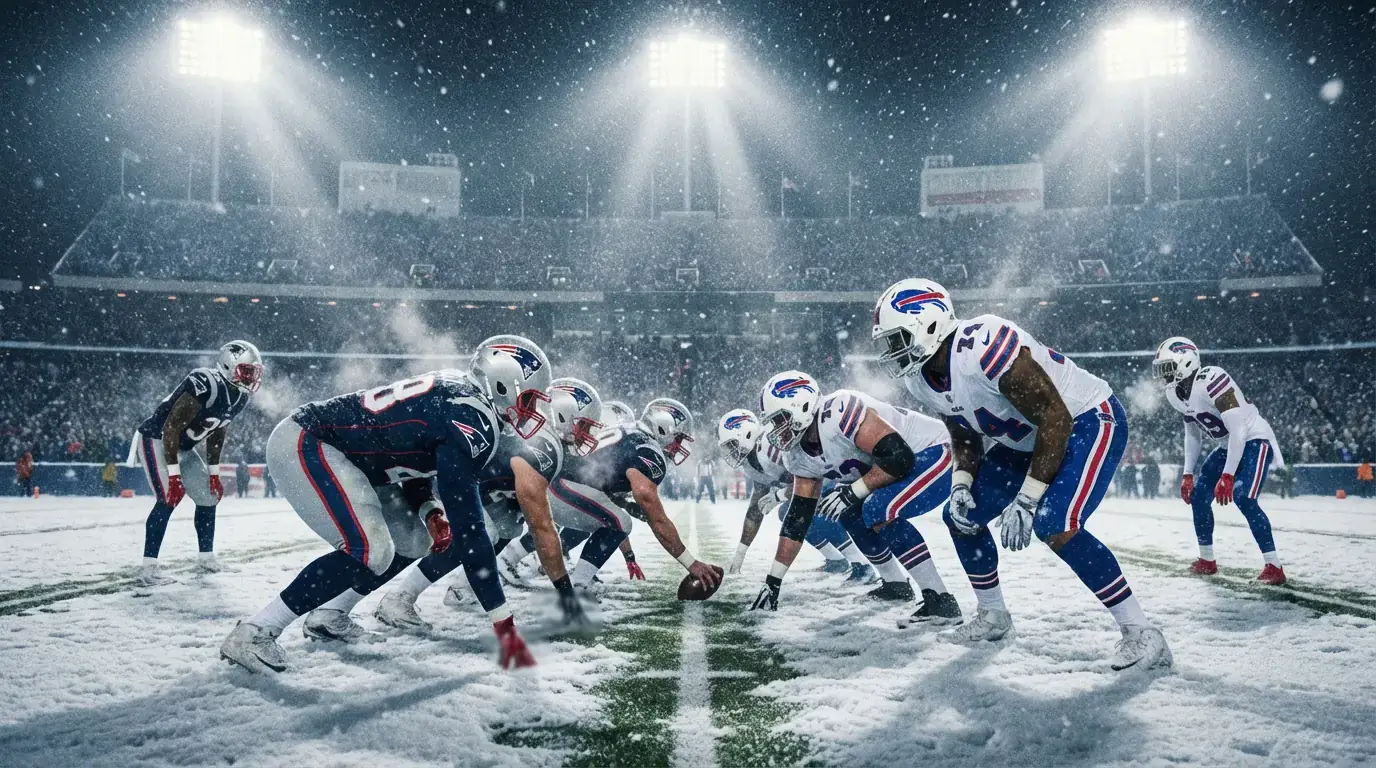
One common mistake is overweighting snow as a scoring suppressant. Television coverage makes snowy games look more dramatic than they often are in terms of scoring impact. Light snow — flurries with accumulation under two inches — has a negligible effect on game totals. The visual is striking, but the playing surface remains functional, quarterbacks can grip the ball, and receivers can run routes without significant impairment. Heavy snow with significant accumulation is a different story, but those conditions are rare even in cold-weather cities and are usually flagged well in advance.
Temperature and Altitude
Temperature alone is a weaker predictor of scoring than wind or precipitation. Cold weather reduces hand flexibility and can affect ball handling, but the impact is modest compared to the mechanical disruption caused by wind. Games played below 20 degrees Fahrenheit show a slight scoring depression — roughly 1 to 2 points on average — but the effect is inconsistent and often overwhelmed by other variables.
The more important consideration is cold temperature combined with wind, which produces wind chill effects that compound the problems of each factor individually. A 15-degree day with 20 mph wind feels like minus-5 and creates conditions where passing is severely limited, kicking accuracy drops sharply, and game flow tilts heavily toward the running game. The wind chill index is a better predictor of scoring impact than raw temperature because it captures the combined effect that players actually experience on the field.
Altitude deserves a mention because of one specific venue: Empower Field at Mile High in Denver. At 5,280 feet above sea level, the thinner air allows the football to travel farther on both passes and kicks. Punts carry extra distance, field goal range extends by roughly 5 yards, and deep balls have slightly different flight characteristics. The effect on total scoring is modest — Denver games do not consistently go over at a higher rate than other venues — but the altitude does interact with other weather factors in unusual ways. Wind at altitude has a different aerodynamic effect than wind at sea level, and visiting teams may experience subtle conditioning challenges that affect late-game performance.
Building Weather Into Your Betting Process
Integrating weather into your handicapping does not require a meteorology degree. It requires a systematic approach to gathering forecast data and a framework for translating that data into line adjustments.
The first step is identifying which games are weather-relevant. Approximately one-third of NFL games each week are played outdoors in stadiums without a retractable roof. These are the only games where weather matters. Indoor games — anything played in a dome or a closed-roof stadium — are immune to weather effects and should be analyzed purely on team quality and matchup dynamics. Knowing which stadiums are outdoor versus indoor is baseline knowledge that saves you from wasting time analyzing weather for games played in climate-controlled environments.
The second step is sourcing reliable, stadium-level forecasts. Generic city forecasts are insufficient because wind conditions can vary significantly based on stadium orientation, surrounding terrain, and elevation. Several weather services provide hourly forecasts for specific geographic coordinates, and plugging in a stadium’s location gives you more precise data than a city-wide overview. Check these forecasts on Saturday evening and again on Sunday morning — the closer to kickoff, the more accurate the prediction.
The third step is applying adjustments. A reasonable starting framework is to reduce your projected total by 2 to 3 points for games with sustained winds above 15 mph, by an additional 1 to 2 points for heavy precipitation, and by a combined 4 to 6 points for the wind-plus-rain scenario. These adjustments are approximations, not exact figures, and they should be calibrated against your own tracking data over time.
The Forecast That Nobody Reads
Weather is one of the few variables in football betting that is simultaneously free, publicly available, quantifiably impactful, and persistently underpriced by the market. The forecast is there for anyone to read. The historical data on weather-adjusted scoring is there for anyone to analyze. And the totals lines on weather-affected games are there for anyone to bet. Yet the majority of recreational bettors never incorporate weather into their process beyond a passing glance at the temperature.
The reason is simple: weather analysis is not exciting. It does not produce the dopamine hit of backing a star quarterback or fading a rival team. It produces small, methodical adjustments to projected totals — the kind of grinding, incremental work that compounds over a season but never generates a story worth telling at a bar. The bettor who takes the under in a 22-mph wind game is not going to brag about it on Monday morning, even if the game finishes 13-10 and the under cashes comfortably.
But profitability in football betting has never been about excitement. It has been about identifying the spots where the market consistently misprices an outcome and showing up every time those spots appear. Weather games are one of those spots. The wind blows, the total drops less than it should, and the under wins at a rate that exceeds the implied probability. It happens every cold-weather Sunday from November through January, and the bettors who notice it keep cashing quietly while the rest of the market watches the highlights and wonders where the scoring went.
