

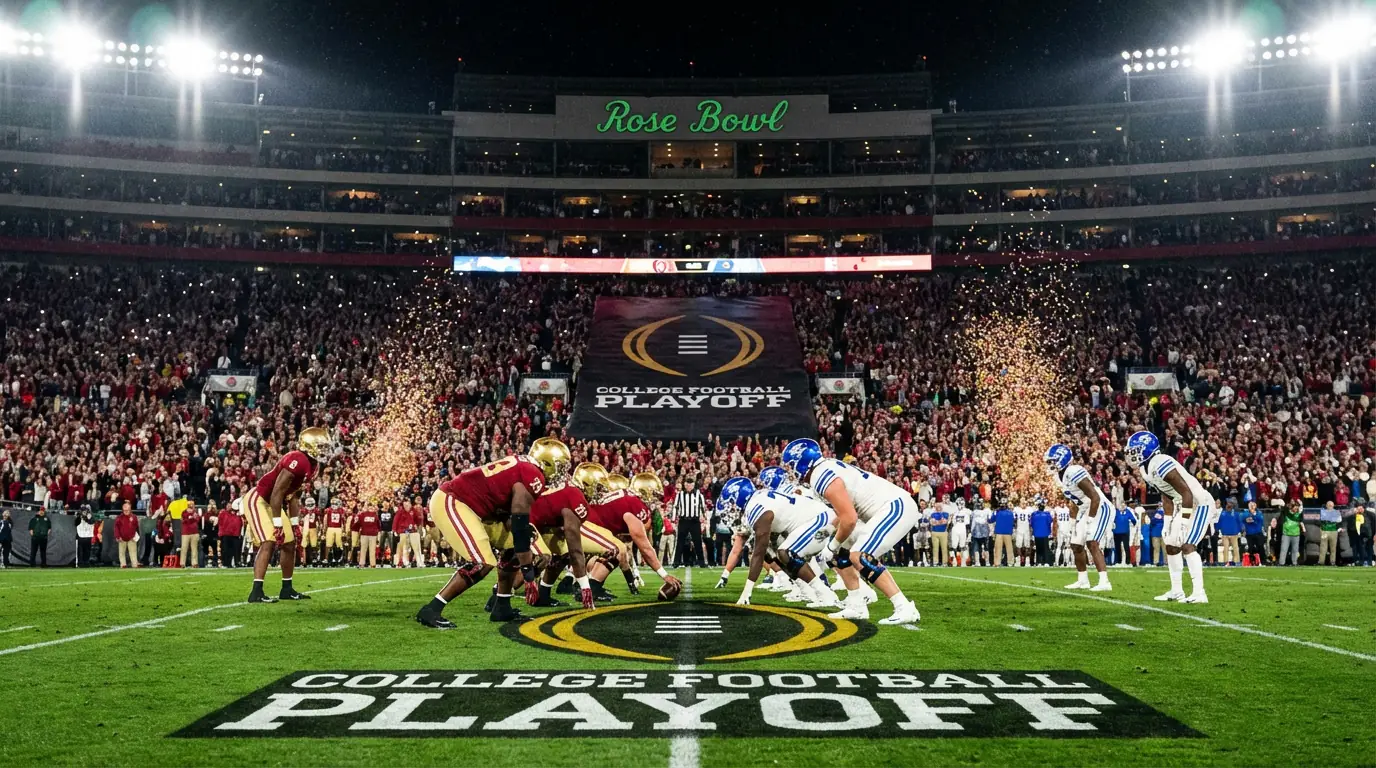
The College Football Playoff has transformed the end of the college football season from a fragmented bowl system into a structured postseason bracket that concentrates the best teams, the highest stakes, and the heaviest betting volume into a compact window. The expanded 12-team format — now the standard in 2026 — has made the playoff more inclusive, more unpredictable, and significantly more interesting from a betting perspective than the four-team era that preceded it.
The expansion also created new betting markets. More teams mean more futures to price, more matchups to handicap, and more first-round games between teams whose styles and talent levels may diverge dramatically. For bettors, the 12-team playoff is a richer, more exploitable market than the old format — provided you understand the dynamics that make it unique.
CFP Futures: Timing and Betting Strategies
College Football Playoff futures — which team will win the national championship — open in the spring and stay active through the playoff bracket announcement in early December. The market operates on the same principles as NFL Super Bowl futures: early prices reflect maximum uncertainty and offer the longest odds, while late prices reflect accumulated information and tighter numbers.
The pre-season window is where the most aggressive value plays are available. Teams with elite recruiting classes, returning star quarterbacks, and favorable early-season schedules can be identified months before the season starts. If your evaluation of a team’s roster talent exceeds the market’s assessment, the June or July price will be the cheapest ticket you find. The risk is that pre-season projections in college football are less reliable than in the NFL because roster turnover is higher (players transfer, declare for the draft, or lose starting jobs) and coaching changes can reshape a program overnight.
The mid-season window — roughly Weeks 6 through 10 — offers a different kind of opportunity. By this point, teams have played enough games to generate meaningful performance data, and the playoff picture is beginning to take shape. Teams that have suffered an early loss but remain talented and well-coached see their championship odds lengthen disproportionately because the public treats a single loss as disqualifying. In the 12-team playoff format, a one-loss team from a major conference is virtually guaranteed a spot if they win their conference championship, and even a two-loss team has a realistic path. Buying futures on teams whose odds have inflated due to a single loss is one of the most consistently profitable angles in college football futures betting.
The post-selection window — from the bracket announcement to the first-round games — is the shortest but most informationally rich. You know the exact matchups, the seedings, the home-field assignments (first-round games are hosted by the higher seed), and the specific stylistic matchups that will determine each game. Futures prices at this point are tighter, but the ability to evaluate specific head-to-head dynamics gives you a sharper analytical edge than the broad-stroke roster evaluation that drives pre-season pricing.
Evaluating CFP Contenders
The factors that predict college football playoff success overlap with but are not identical to the factors that predict regular-season success. Regular-season performance is necessary for qualification, but the playoff introduces a different competitive environment — single-elimination games against elite opponents, often in neutral or hostile venues, with two to four weeks of preparation time.
Quarterback play is the single strongest predictor of playoff success. The last decade of CFP games has been dominated by teams with experienced, high-level quarterbacks who can perform under pressure against elite defenses. First-year starters and game-manager types have consistently underperformed in playoff settings, even when their teams had superior talent on paper. If your championship futures analysis begins and ends with one question, it should be: which teams have a quarterback capable of winning two or three games against top-ten competition?
Defensive quality, specifically in the secondary, is the second key factor. Playoff games tend to feature the most talented offensive players in college football, and teams with weak pass defenses get exposed in ways the regular season may not reveal. A secondary that looked adequate against mid-tier conference opponents might get torched by a Heisman-caliber quarterback throwing to NFL-bound receivers. Evaluating a team’s defensive back room — talent, depth, experience — is essential for projecting playoff viability.
Coaching experience in high-stakes games matters more than most models account for. Coaches who have navigated the playoff before — managing preparation, game-day adjustments, and the emotional intensity of elimination games — perform measurably better than first-time playoff coaches. This is partly a skill effect (experienced coaches are better at game-planning for specific opponents) and partly a selection effect (coaches who reach the playoff repeatedly tend to be the best in the sport). Either way, the data supports weighting coaching pedigree in your CFP evaluation.
Heisman Trophy Futures
The Heisman Trophy market is one of the most narrative-driven in all of sports betting. The award goes to the most outstanding player in college football as voted by sportswriters, broadcasters, and former winners, and the voting is heavily influenced by storylines, team success, and media visibility. Betting the Heisman is not a pure performance prediction — it is a prediction about which player will produce elite statistics on a winning team while generating enough media attention to capture the voters’ imagination.
Quarterbacks dominate the Heisman ballot. In the modern era, the award goes to a quarterback roughly 70-80% of the time, and the winning quarterback almost always plays for a team ranked in the top ten. Running backs and wide receivers can win, but they need a historic season — 2,000 rushing yards or equivalent — combined with a team record that puts them in the national spotlight. Defensive players are effectively ineligible for the Heisman in practice, regardless of how dominant their performance is.
The optimal Heisman futures strategy is straightforward: identify the two or three quarterbacks most likely to combine elite individual production with a top-five team record, and bet them at the best available price before the season starts. Pre-season favorites are frequently underpriced because the market gives too much weight to the field of long shots who have almost no historical precedent for winning. If the pre-season favorite is listed at +300 and your analysis gives him a 35% probability of winning, that is a clear value bet — the implied probability at +300 is only 25%.
Mid-season entries work when a quarterback emerges as a frontrunner due to a hot start that the pre-season market did not anticipate. A quarterback who throws 20 touchdowns in his first five games on a 5-0 team will see his Heisman odds shorten dramatically, but if the market has not fully caught up to his statistical dominance, the in-season price can still offer value. The key is to act before the narrative solidifies in the media — once ESPN starts running weekly Heisman Watch segments featuring the player’s name, the price has already moved.
Betting Individual CFP Games
Once the bracket is set, the individual playoff games become the most heavily bet college football games of the season. The market dynamics in these games resemble NFL playoff betting: compressed spreads, concentrated public money on favorites, and heightened media attention that amplifies casual participation.
First-round games, hosted by the higher seed on their home field, introduce a home-field advantage variable that the later rounds do not have. College football home-field advantages are generally larger than in the NFL — estimated at 3 to 4 points on average, but reaching 5 to 7 points at particularly hostile venues. A first-round game at a raucous SEC stadium carries a meaningful home-field premium that the market must price, and the public tends to overweight the seed differential while underweighting the specific venue effect.
The semifinal and championship games are played at neutral sites, which removes the home-field variable but introduces travel and preparation considerations. Teams with longer travel distances and less experience playing at neutral sites may face subtle disadvantages that are not reflected in the spread. These effects are small — perhaps half a point — but in a game between closely matched teams, half a point matters.
Prop markets for CFP games are expanding but remain thinner than NFL playoff props. The available markets typically cover the starting quarterbacks and top skill players, with limited options for secondary players and defensive contributors. The pricing tends to carry higher vig because the volume does not justify the tight margins that NFL prop markets offer. As with regular-season college props, the opportunity exists in matchup-specific analysis that the sportsbook’s model does not fully capture.
The Bracket as a Betting Map
The 12-team College Football Playoff bracket is not just a tournament structure — it is a betting map that reveals which markets offer the most value at each stage of the postseason. The first-round games, with their home-field advantages and wider talent gaps, present the most predictable outcomes and the narrowest edges. The quarterfinals and semifinals, where the field has narrowed to the best eight and then four, offer tighter matchups and more analytical complexity. The championship game is a single event with two weeks of preparation, maximum public attention, and the highest betting volume of the college football season.
The bettor who approaches the playoff as a structured sequence — evaluating each round’s unique dynamics rather than treating every game identically — has an advantage over the bettor who simply picks a bracket and hopes. The first round rewards roster-depth evaluation and home-field analysis. The quarterfinals reward schematic matchup evaluation, particularly how specific offensive systems attack specific defensive schemes. The semifinals and championship reward coaching analysis and the ability to project how teams with extensive preparation time will adjust to each other’s tendencies.
Each round is a different test, and the market’s efficiency increases as the tournament progresses because the remaining teams receive more analytical attention. The edges are largest in the first round, where the information asymmetry is greatest, and smallest in the championship game, where every data point has been analyzed to exhaustion. Allocating your playoff betting capital accordingly — more in the early rounds, less in the final — is a structural decision that aligns your bet sizing with the available edge, which is the definition of smart capital deployment.
