

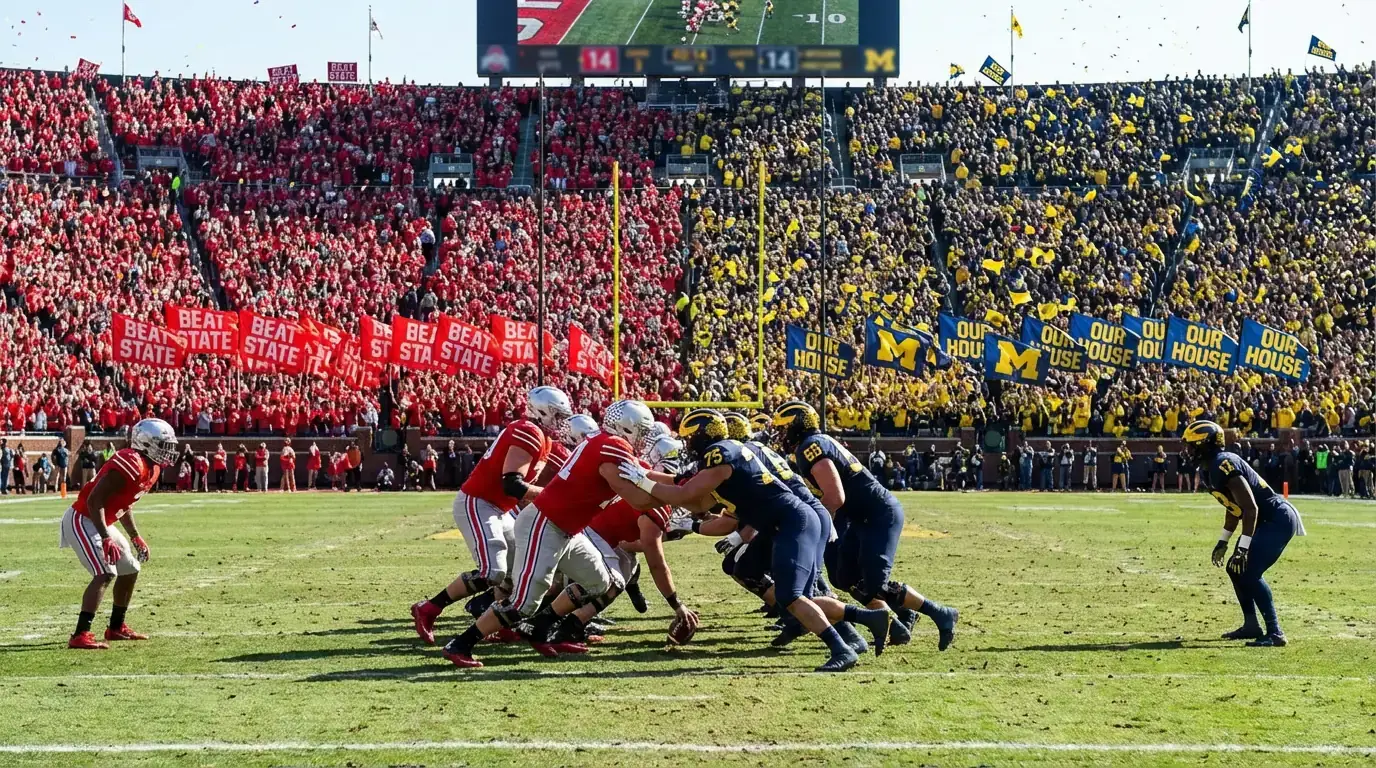
The final stretch of the college football calendar — rivalry week and bowl season — occupies a peculiar position in the betting market. These are the games with the most emotional weight, the longest historical traditions, and the widest variance between what the data says and what actually happens on the field. Rivalry games defy spreads with regularity. Bowl games feature teams with wildly different motivation levels. And the betting public, already prone to emotional decision-making, becomes even more susceptible to narrative-driven analysis when the stakes feel personal.
For the prepared bettor, this stretch is opportunity season. The inefficiencies that exist in rivalry and bowl games are different in nature from those in the regular-season market, and they require a different analytical lens — one that accounts for motivation, roster attrition, and the unique dynamics of games that sit outside the normal competitive framework.
Rivalry Games: Why the Spread Is Misleading
College football rivalries — Michigan-Ohio State, Alabama-Auburn, Army-Navy, Texas-Oklahoma — consistently produce outcomes that are closer than the talent gap would suggest. The underdog covers at a historically elevated rate in rivalry games, and the effect is large enough to be statistically significant across decades of data.
The reason is not mystical. It is motivational and psychological. In a rivalry game, the underdog has every reason to play above its normal level. The game means more to the players, the coaching staff has specifically prepared for this one opponent for the entire season, and the emotional intensity narrows the performance gap between teams that might be separated by multiple tiers of talent in a neutral context. The favorite, meanwhile, faces the reverse dynamic: the pressure of expectations, the possibility of complacency (especially in years where the rivalry game is not critical for playoff positioning), and the disruption to routine that a charged atmosphere creates.
The market knows this pattern exists but does not fully price it. Spreads on rivalry games are set primarily on team quality, schedule context, and standard model inputs. The rivalry effect — the tendency for these games to play closer than the line — is acknowledged but underweighted, partly because it is difficult to quantify precisely and partly because the public money in rivalry games tends to favor the better team regardless. The result is that the underdog in a major rivalry game gets a spread that is slightly too wide, and taking the points has been a quietly profitable angle for years.
Not all rivalries are created equal in terms of the spread compression effect. The strongest effect appears in rivalries with a long history of competitive games, strong emotional stakes for both fan bases, and an underdog with genuine motivational incentive (such as a team that is having a disappointing season but views the rivalry game as a chance to salvage something meaningful). The weakest effect appears in rivalries where the talent gap has become so large that the underdog is genuinely outmatched regardless of motivation — a five-win team playing a twelve-win team in a rivalry context is still going to struggle, even with maximum effort.
Bowl Season: The Motivation Gap
Bowl season introduces a variable that barely exists during the regular season: asymmetric motivation. Not every team playing in a bowl game wants to be there, and not every team that wants to be there wants to be there equally. This motivation gap is the single most important factor in bowl-game handicapping, and the market consistently underprices it.
The most common motivation disparity occurs when a team with playoff aspirations that fell short is placed in a consolation bowl. A team that was ranked fifth and expected to make the playoff but finished sixth plays its bowl game with significantly less enthusiasm than a team that earned its first bowl appearance in a decade. The first team views the game as a disappointment; the second views it as a celebration. On paper, the first team is better. On the field, the motivation gap can close or even reverse the talent advantage.
Coaching changes amplify the motivation problem. A head coach who accepts a job at another school before the bowl game is played creates a leadership vacuum that affects preparation, player commitment, and game-day intensity. Players who were recruited by and loyal to the departing coach may view the bowl game as irrelevant — especially seniors who have no future obligation to the program. Teams with lame-duck coaching staffs have historically underperformed their bowl-game spreads, and the effect is pronounced enough to be a reliable betting angle.
Player opt-outs have become the most visible manifestation of the motivation gap in the modern era. Star players with NFL draft aspirations increasingly skip bowl games to avoid injury risk, and their absence directly affects the team’s on-field quality. A team missing its starting quarterback, top wide receiver, and best defensive player is not the same team that earned its regular-season record, and the spread may not fully account for the cumulative impact of multiple opt-outs. Monitoring opt-out announcements — which typically come in the days and weeks between the regular season and the bowl game — is one of the highest-value information-gathering activities in December.
Historical Trends Worth Tracking
Several bowl-season trends have held up across decades of data and are worth incorporating into your handicapping, though none should be applied blindly without considering the specific circumstances of each game.
Underdogs in bowl games cover at a slightly higher rate than during the regular season. The effect is small — roughly 1-2 percentage points above the baseline — but it is consistent and reflects the motivational dynamics described above. The favorite in a bowl game is more likely to be the team with less to prove, and the public is more likely to bet on the name-brand team regardless of the context, pushing the spread slightly beyond fair value.
Teams with longer preparation periods perform better relative to expectations. Bowl games with three to four weeks of preparation time allow underdog coaching staffs to game-plan specifically for the favorite’s tendencies, narrowing the schematic gap that might be insurmountable during the regular season. This preparation effect is most visible in matchups between teams from different conferences that have never played each other, where the novelty of the opponent gives the better-prepared staff an informational edge.
Low-profile bowls — the early-December games between 6-6 and 7-5 teams — are among the softest markets in college football. These games attract minimal handle, receive almost no sharp attention, and feature teams whose motivation can swing wildly depending on coaching stability, player availability, and the general sense of whether the program views the game as a reward or an obligation. The betting public largely ignores these games, which means the sportsbook’s line is set by the model and left alone. For bettors willing to dig into the specifics — roster reports, coaching status, opt-out lists — these are the games where the informational edge is largest.
Conference mismatches produce stylistic dynamics that the market sometimes misprices. When a Big 12 team built on spread passing faces an SEC team built on physical defense, the tempo and style clash creates uncertainty about game flow that standard models handle imperfectly. Similarly, when a Group of Five team with an unusual offensive system faces a Power Four team that has never seen that scheme, the preparation-time variable becomes especially important. The Group of Five coaching staff has been running their system all season; the Power Four team is installing a defensive game plan from scratch.
A Practical Bowl-Season Workflow
The bowl schedule spans roughly three weeks and includes 40-plus games. The volume is overwhelming if you try to evaluate every matchup, and the temptation to bet heavily because games are available every day is real. A structured workflow keeps you selective and focused on the games where your edge is genuine.
Step one: immediately after the bowl matchups are announced, create a watchlist based on motivation analysis. Flag games where one team has a coaching change, significant opt-outs, or a clear motivational disadvantage. These are your primary targets for further investigation.
Step two: monitor opt-out and injury announcements daily. Bowl season is the one period of the year where roster changes happen continuously over a multi-week window, and the lines may not adjust in real time to each announcement. A spread set when both teams were at full strength might still be sitting unchanged three days after the favorite’s best player opted out. These are the windows where the market is most vulnerable to informed bettors.
Step three: evaluate the preparation-time dynamic for your flagged games. How long has each team had to prepare? Is this a cross-conference matchup where unfamiliarity creates an analytical opportunity? Does one team’s coaching staff have a reputation for superior bowl preparation?
Step four: compare your projected spread to the posted line. If the gap exceeds your threshold — typically 2 to 3 points — and the motivational and roster analysis supports your position, place the bet at the best available price.
Step five: size conservatively. Bowl games carry more variance than regular-season games due to the motivation, opt-out, and preparation variables, and the data backing your analysis is less stable than mid-season efficiency metrics. Half-unit to full-unit stakes are appropriate for most bowl bets.
The Games That Remember
There is something about rivalry games and bowl games that resists the neat quantification that drives modern sports betting. The data is useful — historical trends, opt-out lists, spread compression effects — but it cannot capture everything. It cannot capture the senior defensive end playing his final game against the school that did not offer him a scholarship. It cannot capture the walk-on wide receiver who has waited four years for a bowl-game target. It cannot capture the assistant coach who spent three weeks installing a scheme designed to exploit a single weakness he noticed on film in September.
These stories are not analytical inputs. They are not going to show up in your model or your spreadsheet. But they are part of why rivalry games and bowl games produce outcomes that defy the numbers more often than the regular season does. Football is played by human beings, not probability distributions, and the moments where human motivation most diverges from baseline expectation are the moments where the betting market is most likely to be wrong.
The bettor who approaches these games with both a spreadsheet and an awareness of the human element — who understands that motivation is real, that preparation matters, and that some games carry emotional weight that distorts the normal competitive framework — has the fullest possible picture. The numbers narrow the field. The stories explain the outliers. And the games, in the end, remember what the market forgot.
