

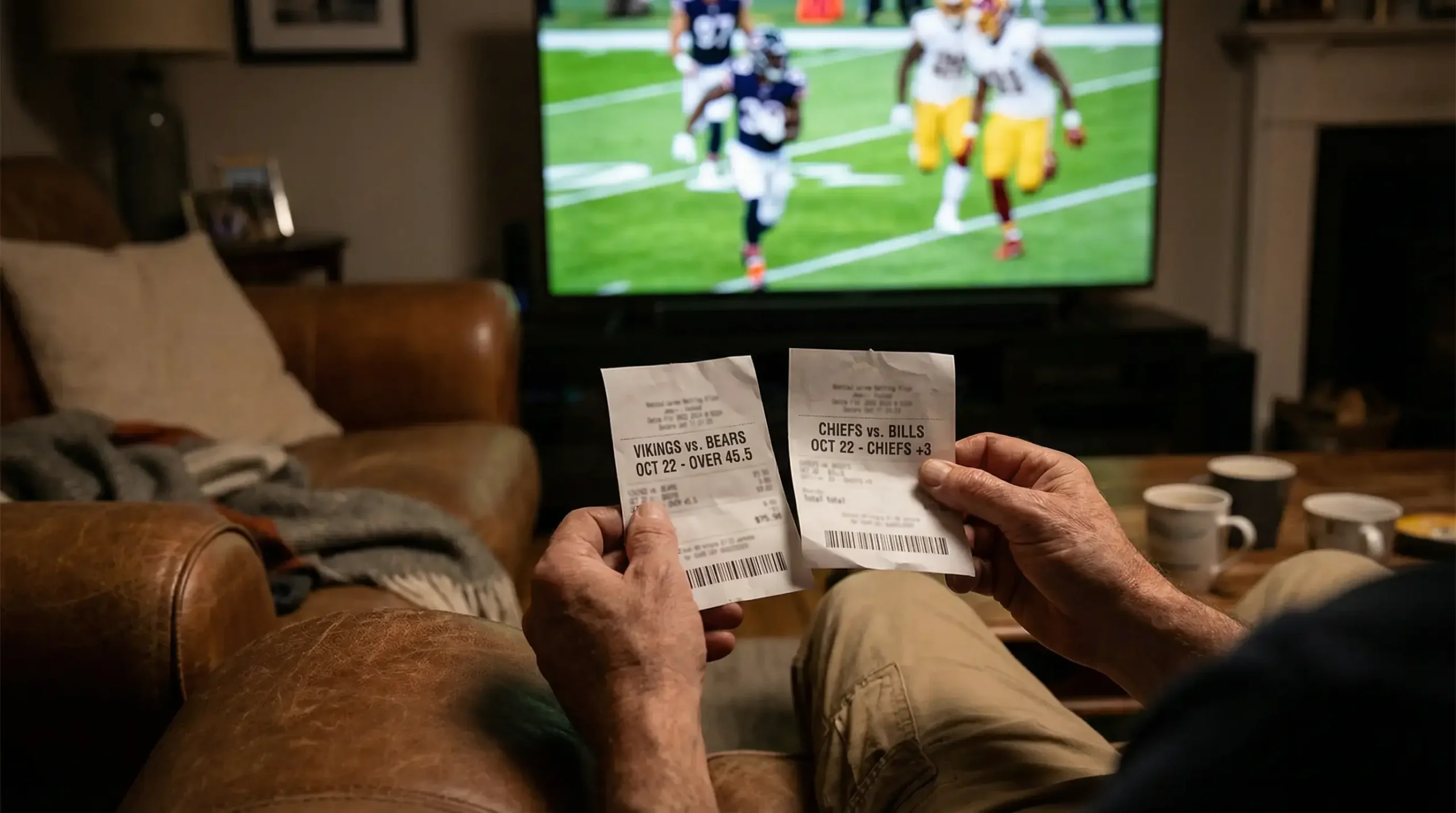
Hedging is the art of placing a second bet that offsets the risk of your first bet, guaranteeing a profit regardless of the outcome. In principle, it sounds like a cheat code — a way to win no matter what happens. In practice, it is a trade-off between certainty and maximum return, and knowing when that trade-off makes sense is one of the more nuanced skills in football betting.
The concept appears most often in the context of futures bets and parlays, where an initial wager at long odds has gained significant value as events have unfolded. Your $50 bet on the Buffalo Bills to win the Super Bowl at +2000 is now worth a potential $1,050 payout, and the Bills are playing in the AFC Championship Game this weekend. Do you let it ride, or do you place a bet on the opposing team to guarantee yourself a profit?
The answer depends on your risk tolerance, your bankroll situation, and whether the expected value of letting the bet ride exceeds the guaranteed return from hedging. These are personal variables, and there is no universally correct answer — only a framework for thinking through the decision clearly.
The Math of Hedging Futures Bets
Hedging a futures bet involves placing a wager on the opposing outcome at the current market price. The goal is to create a position where you profit regardless of which side wins. The math is straightforward once you know the potential payout of your original bet and the current odds on the opposing side.
Suppose you hold a futures ticket on the Bills to win the Super Bowl that pays $1,050 (your $50 stake plus $1,000 profit). The Bills are now in the Super Bowl as +130 underdogs against the NFC champion. The opposing team’s moneyline is -150. To calculate a hedge, you determine how much guaranteed profit you want to lock in from the hedge side, and size the bet accordingly. The opposing moneyline of -150 converts to decimal 1.667. If you want to guarantee roughly $500 from the hedge side, you would bet $500 / (1.667 – 1) = $750 on the opposing team. If the opponent wins, you collect $750 x 0.667 = $500 profit from the hedge, minus the $50 you lose on the futures ticket, for a net of $450. If the Bills win, you collect $1,000 from the futures ticket, minus the $750 hedge loss, for a net of $250. Either way, you profit — though the amounts differ depending on which side wins.
The numbers can be adjusted depending on how much profit you want to guarantee versus how much upside you want to preserve. A smaller hedge bet guarantees less but leaves more potential profit if the original ticket hits. A larger hedge guarantees more but caps the upside more aggressively.
Hedging Parlays: The Mid-Ticket Decision
Parlays present hedging opportunities when all legs except the last one have won. You hold a four-leg parlay that pays +1100, three legs have cashed, and the final leg is a Sunday Night Football game. Your ticket is alive, and the potential payout is $1,200 on a $100 bet. The question is whether to hedge the final leg.
The calculation follows the same logic as futures hedging. Check the current moneyline on the opposing side of your final leg and determine how much to bet to lock in a guaranteed profit. If your final leg is the Eagles -3 and the opposing team’s moneyline is +130 (decimal 2.30), you could bet $400 on the opponent. If the opponent wins, you collect $400 x 1.30 = $520, minus the $100 parlay loss, for a net profit of $420. If the Eagles cover, you collect $1,200 from the parlay, minus the $400 hedge loss and the $100 parlay cost, for a net profit of $700.
The parlay-specific wrinkle is that hedging the final leg of a parlay is mathematically identical to making a decision about two independent bets. Your parlay is functionally a futures ticket at this point — three legs have resolved, and the remaining bet is a single-game proposition. The emotional weight of the “I’m so close to cashing a big parlay” feeling is real but irrelevant to the math. The question is simply: does the final leg offer positive expected value at the current price? If yes, letting it ride maximizes expected profit. If no, hedging captures the value you have already accumulated without risking it on a negative-EV proposition.
The Expected Value Argument Against Hedging
Pure expected-value theory says you should never hedge if your original bet still has positive expected value. Every hedge bet has its own vig, which means hedging always costs you in expected-value terms. The guaranteed profit from hedging is, by definition, lower than the expected profit from letting a +EV position play out.
This argument is mathematically correct and emotionally brutal. Telling someone to let their $1,000 potential payout ride because the expected value of not hedging is $25 higher than the expected value of hedging is technically optimal advice. It is also advice that ignores the reality of how most people experience money. A $500 guaranteed profit and a $1,000 potential profit that requires surviving one more game are not experienced as a $500 difference. They are experienced as certainty versus anxiety, and for most bettors, the marginal utility of the guaranteed money exceeds the theoretical gain from letting it ride.
Professional bettors with large bankrolls — those who place hundreds of similar bets per season — can afford to let every +EV position ride because the variance washes out over the sample. Recreational bettors placing five futures bets per year cannot. The sample is too small for the expected value to converge, and the psychological cost of watching a $1,000 payout evaporate in a single game is high enough to affect future decision-making. Hedging, in this context, is not mathematically optimal but emotionally rational.
Partial Hedging: The Middle Path
The binary framing of “hedge or don’t hedge” misses the most practical option: partial hedging. Instead of locking in a guaranteed profit that eliminates all upside, you hedge a portion of the position — enough to secure a meaningful return if the original bet loses, while preserving significant upside if it wins.
The approach works like this. Using the earlier Super Bowl example, instead of betting $750 on the opposing team for a full hedge, you bet $300. If the opponent wins, you collect roughly $200 from the hedge bet, losing $50 on the original futures ticket, for a net of $150. Not a windfall, but a positive result on a position that could have been a total loss. If the Bills win, you collect $1,000 from the futures ticket, minus the $300 hedge loss, for a net of $700. You have reduced the maximum payout from $1,000 to $700, but you have also eliminated the possibility of walking away with nothing.
Partial hedging is the most popular approach among experienced bettors because it respects both the math and the psychology. It acknowledges that expected value is not the only consideration — that risk management, emotional sustainability, and the practical impact of guaranteed money all matter in a world where sample sizes are finite and bankrolls are not unlimited.
The optimal partial hedge size depends on your individual circumstances. A bettor with a large bankroll relative to the potential payout might hedge only 10-20% of the position, preserving most of the upside. A bettor for whom the potential payout represents a meaningful financial outcome — multiple weeks of salary, for example — might hedge 50-70% and prioritize security. There is no single correct number, and anyone who tells you otherwise is optimizing for a variable that does not apply to your specific situation.
When Not to Hedge
Hedging makes sense when you are protecting a large potential payout against a single remaining event. It does not make sense in several common situations where bettors apply it incorrectly.
Do not hedge a straight bet that is winning at halftime. If you bet the Eagles -3 and they lead 21-7 at the half, the live spread might offer the opposing team at +10. Placing a bet on the opponent to “guarantee” a profit means you are paying vig on a second bet that offsets the first, reducing your expected value on both positions. The original bet either wins or it does not. Taking a live bet on the other side is not hedging — it is placing a new bet that happens to oppose your first one, and unless the live line offers genuine value, it is just adding vig to your total exposure.
Do not hedge futures bets too early. If you hold a Super Bowl futures ticket and your team wins its Week 12 game to move to 9-2, the temptation to hedge is premature. The team still needs to win several more games and survive the playoffs. Hedging now means placing a bet at a price that reflects weeks of remaining uncertainty, which is expensive. The better approach is to wait until the final one or two games before the outcome is decided, when the hedge bet captures the most concentrated remaining risk at the most efficient price.
Do not hedge for the sake of hedging. Sometimes the right move is to let the bet ride because the expected value of the remaining position is significantly positive. If your model gives the Bills a 45% chance of winning the Super Bowl and the moneyline implies 38%, the remaining expected value is substantial, and hedging sacrifices more in EV than it gains in certainty. Save the hedge for situations where the EV gap is small and the guaranteed profit is meaningful relative to your bankroll.
The Insurance You Write for Yourself
Hedging is often described as a strategy, but it is more accurately described as insurance — a financial product you create and sell to yourself. Like all insurance, it has a cost. The premium you pay is the expected value you sacrifice by placing a negative-EV hedge bet. The benefit you receive is a reduction in variance and the psychological comfort of a guaranteed outcome.
Whether that insurance is worth buying depends on the same factors that determine whether any insurance is worth buying: how large is the potential loss relative to your total resources, how likely is the loss to occur, and how much do you value the certainty of knowing the outcome in advance?
For a professional bettor with a $100,000 bankroll, hedging a $500 futures position that could pay $5,000 is rarely worth the EV cost. The potential loss is small relative to total resources, and the bettor will face dozens of similar situations over a career. The law of large numbers works in their favor. For a recreational bettor with a $2,000 bankroll, the same $500 position represents 25% of total resources, and letting it ride on a single game means risking a quarter of the bankroll on one outcome. The insurance premium — the lost EV — is a reasonable price for financial stability.
The most honest framing is this: hedging is always a concession that you value certainty more than maximum expected return. That is not a weakness. It is a preference, and it is a perfectly rational one for the majority of football bettors who are not operating at professional scale. The hedge is the insurance policy you write for yourself, and only you know what premium you can afford to pay.
