

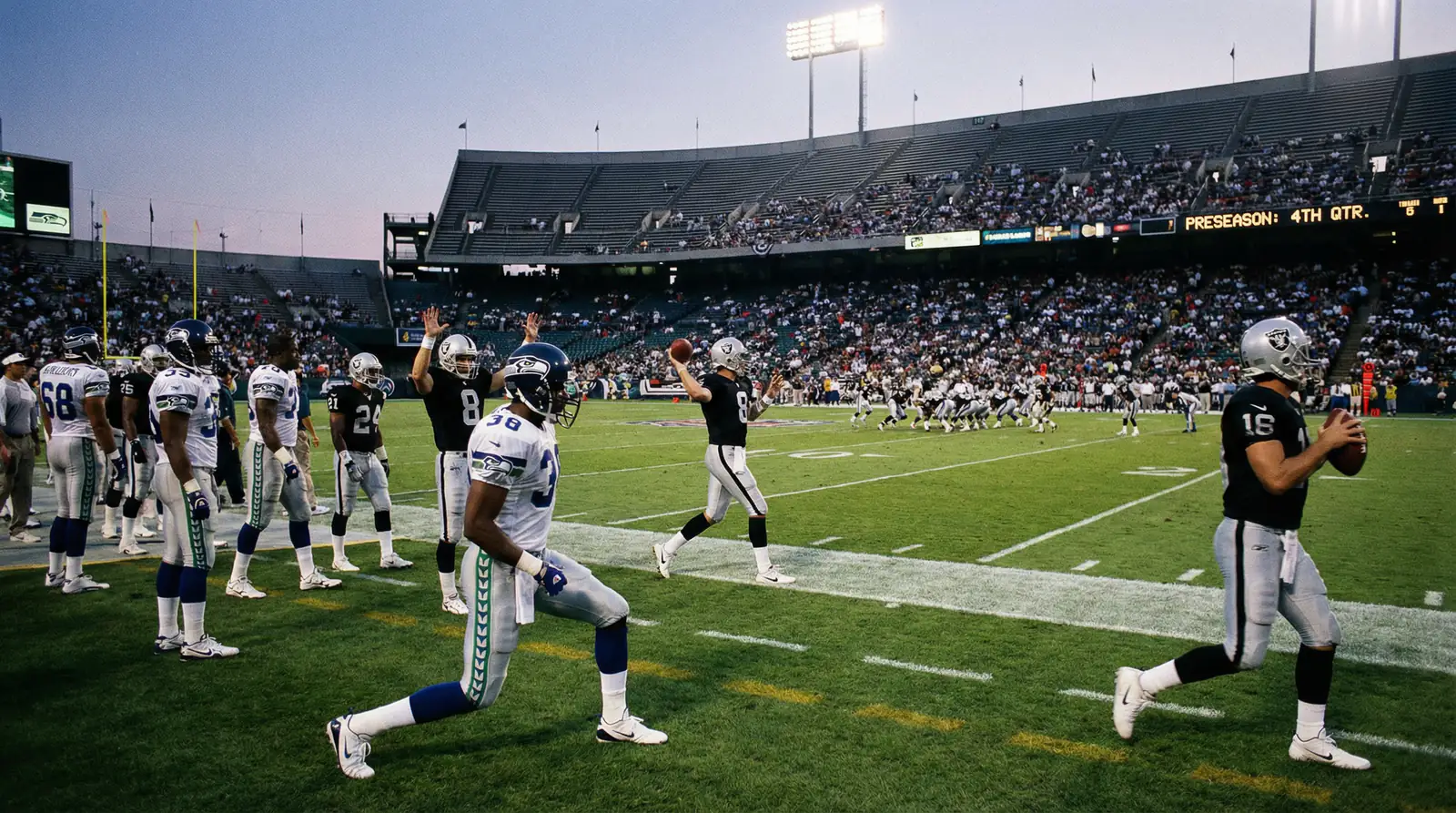
NFL preseason games are strange creatures. The starters play a series or two, then hand the field to backups and roster hopefuls who will be cut before the regular season begins. The outcome of the game is irrelevant to the coaches, meaningless to the standings, and forgotten by everyone within 48 hours. And yet, sportsbooks post lines on every preseason game, and bettors wager real money on them. The question is whether those wagers can be profitable — or whether preseason betting is a trap disguised as an opportunity.
The answer, like most things in sports betting, is conditional. Preseason games are genuinely different from regular-season games in ways that create both inefficiencies and pitfalls. The bettors who profit from preseason are the ones who understand what makes these games unique and adjust their analysis accordingly. The bettors who lose are the ones who apply regular-season thinking to a product that does not follow regular-season rules.
Why Preseason NFL Games Are Unique
The most important difference is playing time distribution. In a regular-season game, the starting quarterback plays every meaningful snap. In a preseason game, the starter might play one drive, one quarter, or not at all — depending on the coaching staff’s evaluation priorities and the player’s contract status. A star quarterback with a $250 million contract has nothing to prove in August, and his coach has no incentive to risk injury in a game that does not count.
This means the talent on the field changes drastically throughout the game. The first quarter might feature a lineup similar to the regular-season starter group, while the fourth quarter features undrafted free agents fighting for the 53-man roster. The team’s overall quality rating is irrelevant because the players contributing to the final score are not the ones who will play in September.
Motivation is the second major difference. Regular-season games carry consequences — wins and losses affect playoff positioning, draft order, and coaching job security. Preseason games carry no consequences beyond roster evaluation. Coaches are not trying to win. They are trying to assess depth, test schemes, and give young players opportunities to demonstrate their readiness. Game plans are simplified, exotic formations are shelved, and aggressiveness on fourth down or late in games is dictated by evaluation priorities rather than competitive strategy.
Scoring patterns also diverge. Preseason games historically produce slightly lower totals than regular-season games, partly because starters play fewer snaps and partly because offensive execution is sloppier with less preparation time. The variance is also higher — a backup quarterback might throw three touchdowns in a half or three interceptions, and the outcome depends on individual talent evaluation that the public has almost no visibility into.
Where Opportunities Exist
The primary source of edge in preseason betting is information about playing-time plans that the public does not incorporate into its analysis. Coaches reveal their preseason depth chart intentions through press conferences, beat reporter interviews, and practice reports throughout the week. A coach who announces that the starters will play the entire first half in the third preseason game is giving you a significant data point that affects the spread and total for that game.
Beat reporters are the most valuable information source for preseason betting. Local reporters covering each team publish daily practice observations, injury updates, and coaching quotes that directly affect who will play and for how long. A report that the starting quarterback will sit while the backup gets extensive reps fundamentally changes the expected scoring output for that team. Following beat reporters for both teams in a preseason game gives you an informational edge that the general public — and often the sportsbook’s initial line — does not fully reflect.
Roster composition analysis provides a secondary edge. Teams with deep rosters — strong second- and third-string units — tend to perform better in preseason because their backups are closer in quality to their starters. Teams with weak depth see a dramatic drop-off when the starters exit. Evaluating roster depth from training camp reports, offseason acquisitions, and undrafted free agent signings gives you a framework for projecting second-half performance that goes beyond the simplistic “which team is better” analysis that drives most preseason betting.
The totals market is generally softer than the spread market in preseason. Sportsbooks have less historical data on preseason scoring patterns for specific roster configurations, and the public tends to anchor on regular-season totals when evaluating preseason games. A team that averaged 27 points per game in the previous regular season might have a preseason total influenced by that number, even though the players on the field in August are fundamentally different from the ones who generated those points in December.
The Traps That Catch Most Preseason Bettors
The biggest trap is treating preseason records as meaningful indicators of regular-season quality. A team that goes 4-0 in preseason has not demonstrated anything about its starting lineup’s ability to win games that count. It has demonstrated that its reserves outperformed other teams’ reserves in games where neither coaching staff was trying to win. Drawing conclusions from this record — or worse, betting regular-season games based on preseason results — is one of the most common and costly errors in football betting.
The second trap is overreacting to individual preseason performances. A backup quarterback who throws for 300 yards in a preseason game against third-string defenders has not proven he is ready for the NFL. A rookie running back who fumbles twice in his preseason debut has not proven he cannot be trusted. The sample sizes are tiny, the competition level is uneven, and the schemes are simplified. Any conclusion drawn from one or two preseason performances is built on noise, not signal.
The third trap is volume. Preseason offers only three games per team in the current format, and the schedule compresses them into roughly three weeks. The temptation to bet every game — because the NFL is back and you have been waiting since February — is powerful but counterproductive. Most preseason games do not present genuine edges because the information landscape is too murky. The disciplined approach is to be highly selective, betting only the games where your information about playing time and roster depth provides a clear advantage.
Vig is also a factor. Some sportsbooks charge higher vig on preseason games — -115 or -120 on each side rather than the standard -110 — to compensate for the increased uncertainty and lower handle. If you are already working with thin edges based on playing-time projections, the higher vig can erase the advantage entirely. Check the pricing before committing to a preseason bet, and pass if the vig is elevated beyond what your edge can absorb.
A Practical Preseason Strategy
The most effective preseason betting approach is narrow and information-driven. The workflow looks like this: identify the two or three games per week where you have the strongest information about playing-time plans, evaluate the roster depth on both sides, project the approximate scoring output based on who is actually playing, and compare your projection to the posted line.
Focus on the third preseason game — traditionally the “dress rehearsal” where starters play the most. The information is most reliable here because coaches typically announce their playing-time plans explicitly, and the game most closely resembles a regular-season contest (at least for the first half). The first and fourth preseason games are the most unpredictable: the first because the plans are undefined and the fourth because the starters rarely play at all.
Keep your stakes small. Preseason edges are real but narrow, and the variance is higher than in regular-season games due to the talent fluctuation throughout the game. A half-unit or quarter-unit stake is appropriate for most preseason bets. If your normal unit is $100, preseason bets should be $25 to $50. The reduced stake reflects the reduced confidence that is inherent in a market with less data, less liquidity, and more unpredictable game flow.
Consider totals over spreads. The total is influenced by both teams’ scoring output, which means your playing-time analysis for both sides contributes to the projection. A spread depends on which team scores more, which introduces an additional layer of variance — one team’s backup quarterback might have a career day while the other’s backup has a disaster, and neither outcome was predictable. Totals smooth out some of this variance because both sides’ contributions are combined.
The August Rehearsal
Preseason football occupies an awkward place in the betting calendar. It is real enough to attract lines and real enough to generate action, but it is not real enough to reward the analytical approaches that work during the regular season. Power ratings, efficiency metrics, and historical trends — the backbone of serious NFL handicapping — are largely useless in August because the players generating the data are not the same ones playing the games.
What replaces those tools is a different kind of homework: roster knowledge, beat-reporter sourcing, and the patience to act only when the information landscape is clear. Preseason rewards the bettor who reads practice reports the way a stock analyst reads earnings calls — not for the headline, but for the detail buried in the third paragraph that tells you something the market has not yet priced.
The rewards are modest. The edges are thin. The season is short. But for bettors who treat preseason as a separate discipline with its own rules rather than a warm-up for the real thing, August offers a handful of opportunities that most of the market is not equipped to exploit. The dress rehearsal is not the show, but there is still a ticket worth buying if you know where to sit.
