

Pregame betting gives you time. You can study matchups, compare lines, consult models, and place your wager hours or days before kickoff. Live betting strips all of that away and replaces it with a ticking clock, shifting odds, and the demand for real-time analysis while the game is happening in front of you. It is the fastest, most dynamic form of football betting — and it is also the form most likely to destroy an undisciplined bankroll.
Live betting, also called in-game or in-play betting, allows you to place wagers after the game has started. The available markets update continuously: the spread adjusts after every scoring play, the total shifts as points accumulate or fail to, and new prop markets open and close throughout the game. The volume of live betting has exploded in recent years, and some estimates suggest that in-game handle now accounts for more than 40% of all NFL betting action at major U.S. sportsbooks.
The appeal is intuitive — you are watching the game, you can see things the pregame line could not anticipate, and you have more information than anyone had before kickoff. The danger is equally intuitive: the sportsbook also has more information, its models update faster than your instincts, and the emotional intensity of watching a live game is precisely the environment where cognitive biases hit hardest.
Mechanics of Live Betting Odds
Live markets operate on a fundamentally different pricing mechanism than pregame markets. Before the game, lines are set by oddsmakers and refined by market action over days. During the game, lines are generated algorithmically — updated by models that process the current score, time remaining, field position, down and distance, and possession in real time.
The speed of these adjustments means that live odds shift within seconds of a significant play. A touchdown might move the spread by 3 to 5 points instantly. A turnover can flip the moneyline. A long pass play that does not result in a score but changes field position will nudge the lines slightly. Between plays, the odds are relatively stable; during plays, they are often locked (the sportsbook suspends betting for a few seconds to avoid being exploited by bettors who react faster than the model updates).
The markets available during a live game are typically narrower than pregame. You will always find the live spread, live moneyline, and live total. Many sportsbooks also offer live player props (next touchdown scorer, next team to score), quarter and half results, and drive-specific outcomes (will this drive result in a score?). The variety depends on the sportsbook and the prominence of the game — a Sunday Night Football broadcast will have far more live markets than a Thursday preseason game.
Pricing in live markets carries higher vig than pregame. The standard pregame spread at -110 might become -115 or -120 in the live environment because the sportsbook needs a wider margin to compensate for the speed at which it must adjust and the risk that its model lags behind real-time events. This higher vig is the tax you pay for the privilege of betting with more information, and it means your analysis needs to be proportionally sharper to maintain the same edge.
Momentum Shifts and How to Exploit Them
Football is a game of runs. A team might dominate the first quarter, controlling time of possession and moving the ball at will, then suddenly give up two turnovers in the second quarter and find itself trailing at halftime. These momentum shifts are the heartbeat of live betting because they create rapid price dislocations — moments where the live line overreacts or underreacts to recent events.
The most common overreaction is to early scoring. If a team falls behind 14-0 in the first ten minutes, the live spread might shift by 10 or more points from the pregame number. The market is essentially extrapolating the early trend and assuming it will continue. But NFL games are 60 minutes long, and early deficits are overcome far more frequently than the live line suggests. Historical data shows that teams trailing by 14 points at any point in the first half still win outright roughly 10-15% of the time, depending on the quality of the teams involved. The live line after a 14-0 deficit often implies a win probability lower than that, which creates value on the trailing team.
The inverse overreaction occurs when a mediocre team jumps out to an early lead against a superior opponent. The live line might not discount the leading team’s quality deficit quickly enough because the model weights the current score heavily. If you believe the pregame spread was accurate and the early scoring was driven by variance (a fluky turnover, a special-teams touchdown), the live line on the favorite who is trailing can offer a better price than anything available pregame.
Underreactions are subtler but equally valuable. A key injury that occurs during the game — a starting quarterback leaving with a concussion, a top corner being helped off the field — might not be fully priced into the live line for several minutes, especially if the broadcast has not confirmed the severity. Bettors who monitor injury reports in real time through team social media accounts or beat reporters can identify these windows before the sportsbook’s model adjusts.
Halftime Betting: The Pause That Resets the Board
Halftime is a unique moment in live betting because the market essentially resets. The sportsbook posts second-half lines — a fresh spread, moneyline, and total that apply only to the points scored after the break. These markets are derived from the pregame line adjusted for the first-half result, and they often present the cleanest opportunities in the live environment.
The logic is straightforward. If the pregame total was 47.5 and 28 points have been scored in the first half, the second-half total might be set at roughly 22.5 to 24.5 — not simply 47.5 minus 28, because the model accounts for expected regression. High-scoring first halves tend to be followed by lower-scoring second halves (offenses cool down, coaches adjust, the clock runs faster when teams protect leads), and low-scoring first halves tend to be followed by higher-scoring second halves as teams become more aggressive with their play-calling.
Second-half spreads work similarly. If the Eagles were -3.5 pregame and lead 17-7 at halftime, the second-half spread might be Eagles -1 or even a pick’em, reflecting the expectation that the trailing team will come out with adjusted schemes and greater urgency. If your analysis of the first-half game film — formations, play calls, defensive adjustments — gives you a view on which team has the schematic advantage in the second half, the halftime line is a direct way to express that opinion without the noise of the first-half result distorting the price.
Halftime markets also carry slightly lower vig than continuous live markets because the sportsbook has time to set the line during the break rather than updating algorithmically in real time. This makes second-half bets the most accessible entry point for bettors who want to participate in live betting without the frenetic pace and elevated vig of in-play markets.
Managing Risk in Live Betting
Live betting magnifies every behavioral weakness that exists in pregame betting and adds a few new ones. The speed of the market rewards impulsive decisions. The visual stimulus of watching the game triggers emotional reactions that override analysis. And the constant availability of new betting opportunities creates a volume problem — it is remarkably easy to place ten or fifteen live bets during a single game without realizing how much cumulative exposure you have taken on.
The first discipline is pre-game preparation for live scenarios. Before the game starts, identify the specific situations that would create live value. Write them down if necessary. If the team you like falls behind by 10 in the first quarter, at what live spread would you bet them? If the starting running back gets injured, how does that change the total? Having a plan before the emotional intensity of the live game takes over prevents reactive betting and keeps your decisions anchored to analysis rather than adrenaline.
The second discipline is bet sizing. Live bets should be smaller than pregame bets — typically half a unit or less. The vig is higher, the information advantage is less certain, and the temptation to chase losses in real time is powerful. Smaller stakes limit the damage when a live bet goes wrong and reduce the emotional weight of each wager, which in turn helps you think more clearly about the next opportunity.
The third discipline is volume control. Set a hard limit on the number of live bets you will place per game — three is a reasonable maximum for most bettors. Without a cap, the constant availability of markets will pull you into marginal situations where the edge is thin or nonexistent. Every bet you place carries vig, and in the live environment that vig is steeper. Ten live bets at -120 each with no edge is a guaranteed bankroll drain, regardless of how confident you felt in the moment.
Before placing wagers while the game is unfolding, ensure you understand exactly where online football betting is legal in your specific jurisdiction.
The Second Screen Advantage
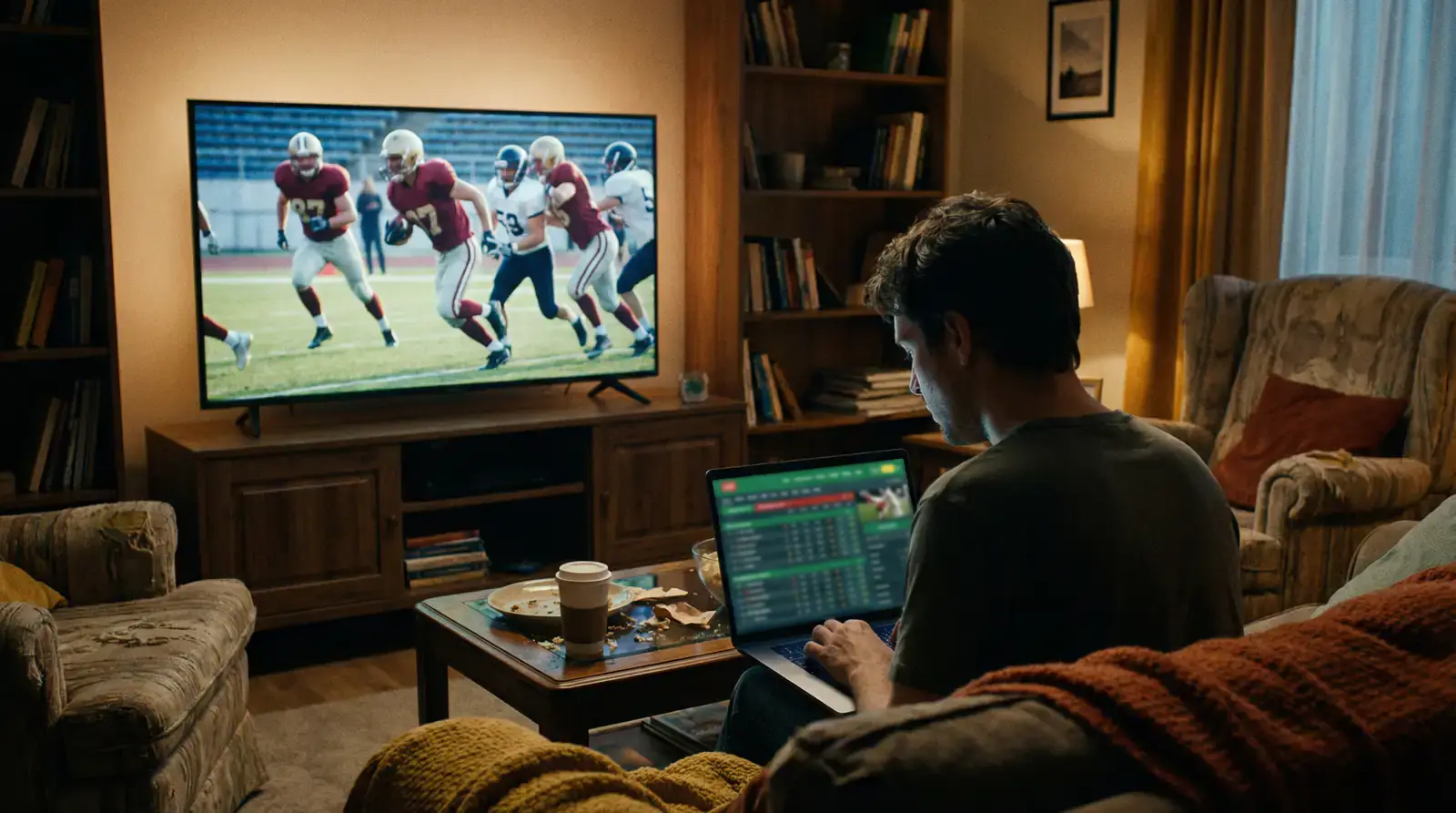
The rise of live betting has created a parallel industry of real-time data tools designed to give bettors an informational edge during games. Win probability models, live EPA trackers, real-time snap count feeds, and instant injury alerts are all available through mobile apps and browser dashboards that run alongside the broadcast. The bettor who watches the game on one screen and monitors data on another has a structural advantage over the bettor who relies solely on what the television shows.
This advantage is not about speed — the sportsbook’s algorithm will always update faster than a human can process information and place a bet. It is about context. The broadcast might show a team completing a 40-yard pass and cutting the deficit to 7 points, which triggers an emotional response that makes the trailing team feel like they are “coming back.” The data screen, meanwhile, might show that the trailing team’s expected points added per play has been negative all game, that the completion was a broken coverage unlikely to recur, and that the live spread has already adjusted to a number that overvalues the comeback narrative.
The second screen does not replace football knowledge. It supplements it. The most effective live bettors combine an understanding of the game — schemes, tendencies, coaching patterns — with real-time analytical tools that cut through the broadcast’s emotional framing. Football is theater, and the broadcast is designed to maximize drama. Your job as a live bettor is to see past the theater and find the price discrepancy hiding behind the highlight reel. The data will not always reveal one. But when it does, the live market is often the last place the sportsbook has corrected, which makes it the first place a prepared bettor should look.
Find real-time updates and comprehensive sportsbook reviews on the best site for football bettors.
